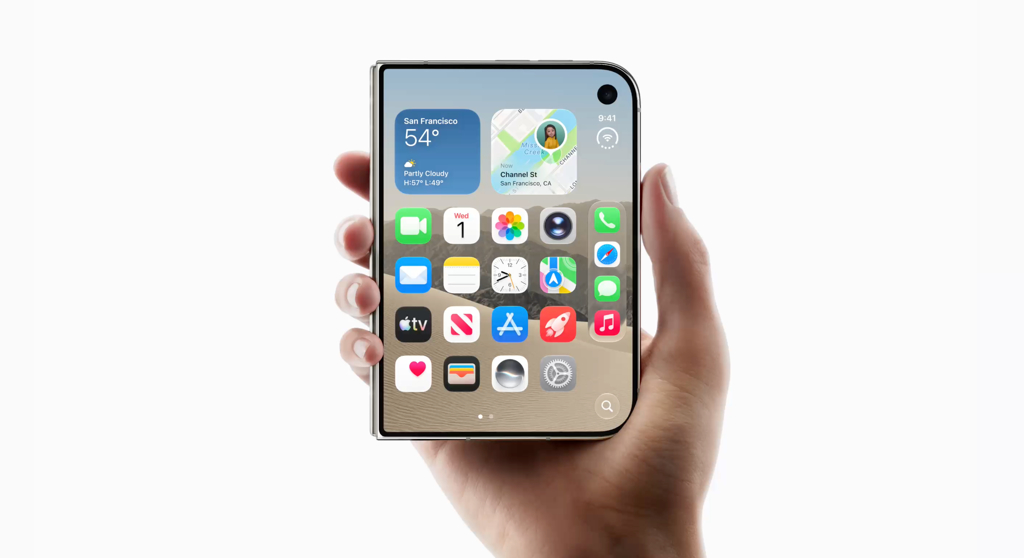
Often, we see designs trickle down from iOS. Android itself was a Blackberry clone before iOS took over the smartphone scene. The design language is more consistent across iOS, there are fewer devices and screen ratios to care for on iOS, and Apple makes it easier to prepare your apps for new versions of iOS (Google throws sand in your face yearly and laughs as you struggle to update two dozen dependencies to SDK 37, all with conflicts). These all make it easier to release new designs on iOS than Android. So, while foldables may have started on Android, they haven’t gotten much design attention from developers except those, like myself, obsessed with the closed outer display of their Motorola Razr who make every app they work on look good on it.
That’s why I’m so excited for the iPhone Duo, as an Android engineer. Design teams are finally going to start helping us prioritize some cool stuff thanks to Apple.
Get them on Board!
One of the biggest struggles as a developer is convincing product managers who do not know the platform, the codebase, the issues in the codebase, or the potential of new ideas, to pick up a project they didn’t come up with themselves. You have to incept them, basically, but getting ahold of a dream machine is getting harder.
Don’t get me wrong! I’ve had the privilege of working with some great product managers. Good product managers will be on top of things, understanding that software engineers aren’t tools for them to use to create a portfolio of features they worked on, that code development isn’t just creating new things, it’s patches, security, updates, tech debt, new technologies, OS and store requirements, and more. There are plenty of self-centered PMs out there who will not think of the end goal of making a better product, especially when it comes to a platform they know little about, usually Android, but there are also some great PMs who like to push a product forward.
The Design Gap
iOS is better designed than Android, full stop. It’s more consistent, easier to use, has lower touch accuracy requirements that make it feel more intuitive, and it’s just nicer. Because of that, people who care about design, product people and designers, for example, are more likely to be on iOS. Because iOS is a status symbol, your boss’s boss’s are also more likely to be on iOS. This means iOS gets priority when it comes to design and new features.
Because so many people use iOS in design and product fields, they often do not know or value how things work on Android. Someone may have been using a foldable phone for years on Android, stating that the view is broken on a small outer display and they need a few days to fix it, only for someone on iOS who has never used a foldable to consider it unimportant. The key is to use data backed pleas, finding plenty of reviews and usage data to show that thousands of people are affected by an issue to prove what we, as users and developers, already know. We have to prove an idea has potential using historical data, which just isn’t how leaps in innovation or virality works. You don’t become the explosive new app everyone wants to try and talk about on Reddit by designing within the bounds of what has already been done.
Apple Does the Excitement for Us
However, now the script will be different. The product managers and upper management with cash to spare will be dropping their money on the iPhone Duo. They’ll be asking questions like, “can we move this navigation bar and controls to the right side,” and “Android has had foldables for years, why didn’t any of you make something like this?” That last one is going to be a hard statement not to get frustrated about, but I implore you, Android engineers, take a deep breath and welcome the new opportunity. Some of it might be sigh-inducing, after all, you’ve been hoping to work on these Android-specific designs for years now, but stick with them, because you’re going to get a lot of cool projects out of this.
Suddenly “parity with the iOS app” will include making layouts for phones like Samsung’s Z Fold 8 and Xiaomi’s 18 Fold (in beautiful red color, which Apple has sadly abandoned for dull mediocrity). We’re going to get some cool projects. Plus, it’s a great excuse to say, “We could do this, but we need to update our minimum SDK and compile SDK to get access to fold state on Android,” or, “Well, we could, but we need to update these views to Compose to get this working, and that means a more reactive and state-driven data layer.” Now you get to handle tech debt and introduce some exciting new features. Win-win!
Android often innovates on things like screen sizes, folding displays, and zoom cameras. But Apple always comes in, does it far better, takes care of the issues that held people back from adopting them on Android, and makes the new features far more popular. Some of that isn’t the fault of Android engineers. We’d have loved to make designs specifically for squat, square, and flip or fold phones. But we just didn’t get the buy-in from management until Apple popularized these features. Because of that, Apple’s about to give Android users and developers a huge boost in design quality, and I can’t wait to get working on it.